
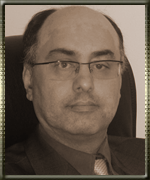
Dr.Khalid Choukri
ELRA Secretary General
ELDA founder & CEO
Evaluations and Language resources Distribution Agency (ELDA)
Paris France
Khalid Choukri – ELDA, CEO and Managing Director
Dr. Khalid Choukri obtained an Electrical Engineering degree (1983) from Ecole Nationale de l'aviation civile (ENAC),
and Masters Degree (1984) and doctoral degrees (1987) in Computer sciences and Signal processing at the Ecole
Nationale Supérieure des Télécommunications (ENST) in Paris.
He was a research scientist at the Signal Department of ENST,
involved in Man-Machine Interaction. He has also consulted for several French companies (e.g., such as Thomson) on various
speech system projects and was involved in SAM, ARS, etc.
In 1989, he joined CAP GEMINI INNOVATION, R&D center of CAP SOGETI
to work as the team leader on speech processing, oral dialogues and neural networks. He managed several ESPRIT projects such
as SPRINT and was involved in many others such as SUNDIAL.
He then moved to ACSYS in September 1992 to take on the position
of Speech technologies manager. Since 1995, he has been the Chief Executive Officer of the European Language Resources
Association (ELRA) and the Managing Director of the distribution. ELDA aims at collecting, commercializing and distributing
Language Resources, as well as collecting and disseminating general information related to the field of Human Language Technologies,
with the mission of providing a central clearing house to the players of the field
Overview on Language Resources & Technologies:
the case of Arabic, Arabic Dialects
and the under resourced languages
The talk will elaborate on the importance of language resources in the digital age and the case of the less resourced languages.
A variety of technologies will be addressed and the status of these for Arabic(s) and the associated languages will be mentioned.
The importance of dialectal varieties will be discussed as well as the new use cases that involve code switching, arabizi input, etc.
The conclusion will focus on suggestions for a roadmap to compile a repository of such resources.

Pr. Allan Ramsay
Professor of Formal Linguistics
School of Computer Science, University of Manchester
Manchester M13 9PL, UK
Allan Ramsay is Professor of Formal Linguistics in the School of Computer Science at the University of Manchester,
having previously been Professor of Artificial Intelligence at University College Dublin.
He has published six books and over 110 refereed journal and conference papers on all aspects of
language processing, from speech through morphology, syntax and semantics to the development of
inference engines aimed at topics in pragmatics.
Since 2001 a large part of his work has been aimed at
topics in Arabic natural language processing, often in partnership with Hanady Mansour Ahmed of Qatar University"
Dependency trees as meaning representations
A system that can 'understand' natural language must be able to carry out inference over sentences of natural language. If someone said "I've just produced a system that can understand English", you would expect it to be able to recognise that if you said "John and Mary have just got divorced" then you would also be committed to saying that "John and Mary were once married" and "John and Mary are not now married"; and that if you said "I'd forgotten to to feed the cats" then you would be admitting that you hadn't fed the cats, whereas if you said "I'd forgotten that I fed the cats" then you would be saying that you had fed them. That's what understanding language means -- that when you hear a sentence, you can link it to your knowledge of the meanings of the words that it contains and work out its simple, obvious consequences.
Traditionally, this task has been approached by translating from natural language into some kind of formal logic, and then using a theorem prover for that logic. This has proved to be extremely difficult. The standard way of doing it involves carrying out syntactic analysis using a hand-written grammar, and then using semantic interpretation rules attached to the rules of the grammar to produce a formal paraphrase (a 'logical form'). Hand-coding grammars for natural language is very difficult; writing parsers that can apply such grammars in a reasonable amount of time is very difficult; and freely occurring text contains strange extra-grammatical constructions which will defeat even the best hand-coded grammars anyway.
Recent approaches to syntactic analysis, then, tend to be data-driven, with either no explicit grammar at all (Malt, SyntaxNet) or with VERY large sets of context-free rules that no-one could reasonably annotate with interpretation rules. But if you have no grammar rules to attach interpretations to, then how can you do compositional translation into a logical form? This talk will discuss recent work on carrying out inference directly on parse trees, and will show how pairwise matching algorithms, of the kind addressed in textual entailment and natural logic, can be embedded in a variant on a standard inference engine to carry out deep reasoning over natural language texts. The talk will be illustrated with examples from both English and Arabic.


Paper Submission: May 15 2017
------------------------------------------------------
Extended Submission Deadline:
June 04 2017
------------------------------------------------------
Acceptance Notification: August 10, 2017
------------------------------------------------------
CR Submission: August 20, 2017
------------------------------------------------------
Registration deadline: September 8, 2017
------------------------------------------------------
Conference Dates: October 11-12, 2017
Email : icalp17@usmba.ac.ma
------------------------------------------------------
Social Networks : 





Quartier Industriel Ain Chkef, Route Bensouda, Fez, Marocco
Phone.:+212 5 35600403, Fax.:+212 5 35600386
Copyright © 2016, Arabic Language Engineering Society in Morocco (ALESM), All Rights Reserved.